How UC Berkeley is closing the math readiness gap

March 30, 2026

In November, a report from UC San Diego raised alarm across the country. One in 12 incoming students tested below middle school proficiency in mathematics — even while maintaining good grades in high school. The report sparked debates on many issues, from grade inflation to standardized testing to inequitable school funding.

UC Berkeley math professor Alex Paulin says his campus’s situation is not as dire as UC San Diego’s, but it does reflect the nation’s general decline in college readiness. 

“A lot of students have taken precalculus or calculus in high school, and they've basically been lied to by their school systems,” said Paulin. “They don't actually know these subjects at all — not enough to do remotely well in the classes here. Ludicrously, their first wake-up call is occurring in their first college midterm, which is mind-blowing.”

About 80 percent of UC Berkeley undergraduates enroll in a math course during college, and many popular majors have math requirements, including physics, chemistry, engineering, and molecular and cell biology. In 2016, the Department of Mathematics decided to assess incoming students’ readiness. They found that around 40 percent of students starting Calculus 1 tested below entry level for the course. Some even needed refreshers on fractions and exponents.

25px spacer to make rows line up
A man with short hair and a short beard in front of a green tree
PROFESSOR ALEXANDER PAULIN

The department knew it faced a major challenge, so in 2020, it asked Paulin and former lecturer Kelli Talaska to devise an intervention. They decided on an online pre-calculus course offered to all first-year students in the summer before arriving on campus. The initial reaction was overwhelming: around 2,000 students signed up. 

Paulin credits the pandemic for that high enrollment — students were stuck at home, craving human interaction. Still, it was a good start toward what would become the Solid Foundations Program.

“Students appreciate the fact that there's something there in the first place, because there really wasn't anything before,” said Paulin. “You were just on your own.”

Today, the Solid Foundations Program continues to run summer and first-semester fall courses, broadening from pre-calculus to cover the “Foundations of Lower Division Mathematics.” Paulin partners with the Student Learning Center to review participant feedback and improve the curriculum each session. 

Paulin is a particularly apt choice to lead a refresher course. He received the Distinguished Teaching Award in 2020 and an Extraordinary Teaching in Extraordinary Times Award in 2021 — the latter related to his work on the Solid Foundations Program. The Daily Californian voted him best instructor three straight years.

“This course is outstanding,” said Drisana Bhatia, a math major who tutored “Foundations of Lower Division Mathematics” last summer and fall. “It’s really well thought-out, pedagogically. Professor Paulin is so experienced with teaching, and the way he creates resources is very student-focused. He has created all these video lectures and worksheets to prepare students for introductory, college-level calculus.”

“What's been done is fantastic, and I've seen it work,” she continued.

Bhatia praised the summer session’s discussion sessions in particular. She joined 30 to 40 students on a regularly scheduled Zoom call, guiding their progress over several weeks. That regularity fostered a supportive learning community that is often hard to find in giant lecture halls.

“It’s a bit of a long game,” said Paulin. “Students aren’t going to suddenly rocket from D’s to A-pluses in the course of their first semester. It comes later. I’ve had a lot of students who, at the start of the year, are blown out of the water by Calculus 1. By the end of the year in Calculus 2, they’re one of the best students in the class. It’s not unusual.”

Paulin’s mission is to retain students in STEM fields (meaning science, technology, engineering, and mathematics). He observed that many students abandon technical majors after struggling in introductory mathematics. By providing tools to bridge these foundational gaps, Paulin aims to help students achieve the baseline proficiency required to excel in professions ranging from research to data analysis to executive management.

“Understanding algebra is foundational to career success and calculus,” said Bhatia. Some of her students intended to become elementary school teachers, and the refresher course helped them feel more confident with the sort of math they would be teaching.

The COVID-19 pandemic disrupted students at a critical time in their development, exacerbating disparities for students lacking private academic support. UC San Diego’s report underscores this phenomenon: The number of first-year students in remedial math courses surged from 32 in 2020 to 390 in 2022. By the fall of 2025, 921 UC San Diego students were taking foundational math courses.

However, many math instructors fear that this is a long-term trend. In the 2024 National Assessment of Educational Progress, high school graduates scored worse in math than in any previous assessment: 45 percent were “below basic.” 

Recognizing the scale of this challenge, the University of California’s Office of the President approached Paulin with a proposal to adapt “Foundations of Lower Division Mathematics” for high school students. The University of California system partners with a nonprofit, the National Education Opportunity Network, to make college credit-bearing courses available in low-income high schools. Knowing that some teachers wouldn’t have math backgrounds, Paulin broke down his materials into smaller pieces with detailed instructions.

“It’s an awesome model, and it was very fortuitous when they contacted me,” said Paulin. “This is very targeted, especially for vulnerable groups. It was a monumental task, but it all came together.”

Last fall, teachers at four schools used Paulin’s materials in their classrooms for three hours a week. “Foundations of Lower Division Mathematics” was part of a handful of courses — and the only one from UC Berkeley — that the state is testing as part of a pilot project. Paulin expects the high school class to run again next fall on a larger scale.

The Solid Foundations Program also plans to host a workshop for high school teachers on college expectations and successful instructional approaches.

UC San Diego’s report argued that the University of California system’s mission as an engine of social mobility meant that its campuses “must be prepared to support students who have been underserved by their prior schooling.” But, it continued, that capacity “is not limitless.”

The Solid Foundations Program has been generously supported since 2016 by Kathy Kwan, and the math department is looking for additional donors to help the program grow. Paulin believes a letter grade will attract more students than the current pass/no-pass system, as will extending the fall course from seven weeks to a full semester. Those changes will allow the department to offer two course credits and secure a larger room to facilitate group learning supported by tutors. This interactive student engagement will be further strengthened in several years when UC Berkeley replaces Evans Hall with a new building dedicated to math. 

Paulin has also been experimenting with OATutor, an open-source adaptive learning tool developed by Zachary Pardos in the School of Education, to make better use of online technology. The tool adapts to the user’s level of knowledge as they work through custom modules. It will integrate with a new online hub for course materials. 

“It's quite an exciting project,” said Paulin. “We have so much material now, so many cool resources. We want to get them out there in a way that students want to interact with, and this seems like the most efficient way to do it.”

25px spacer to make rows line up
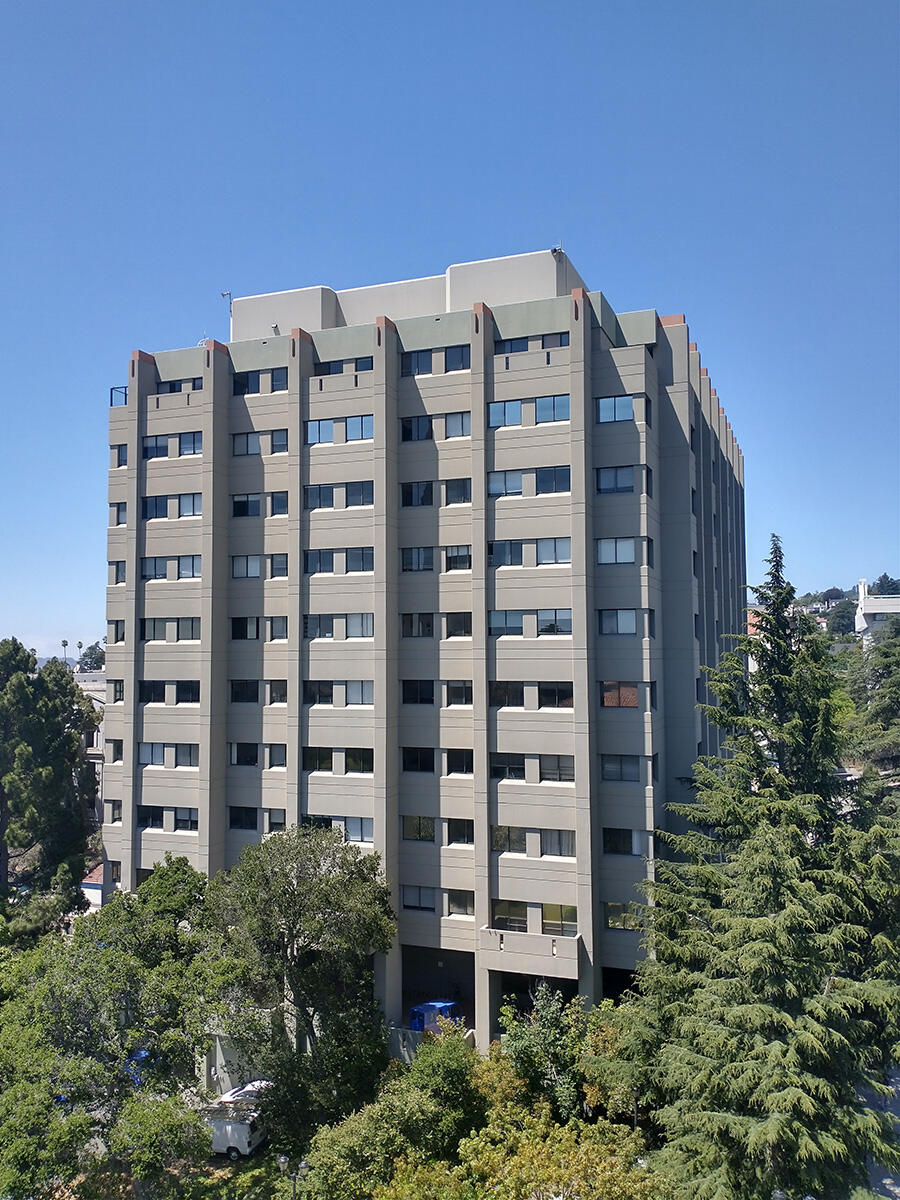
Evans Hall rises above the trees on Berkeley's campus
EVANS HALL, THE CURRENT HOME OF THE DEPARTMENT OF MATHEMATICS
Understanding algebra is foundational to career success and calculus.
Drisana Bhatia
25px spacer to make rows line up