Alex Filippenko named 2026 Dorothea Klumpke-Roberts Awardee

September 8, 2026

The Astronomical Society of the Pacific announced that Distinguished Professor of Astronomy Alex Filippenko will receive its 2026 Dorothea Klumpke-Roberts Award. The award recognizes noteworthy individuals who have helped the public understand and appreciate astronomy.
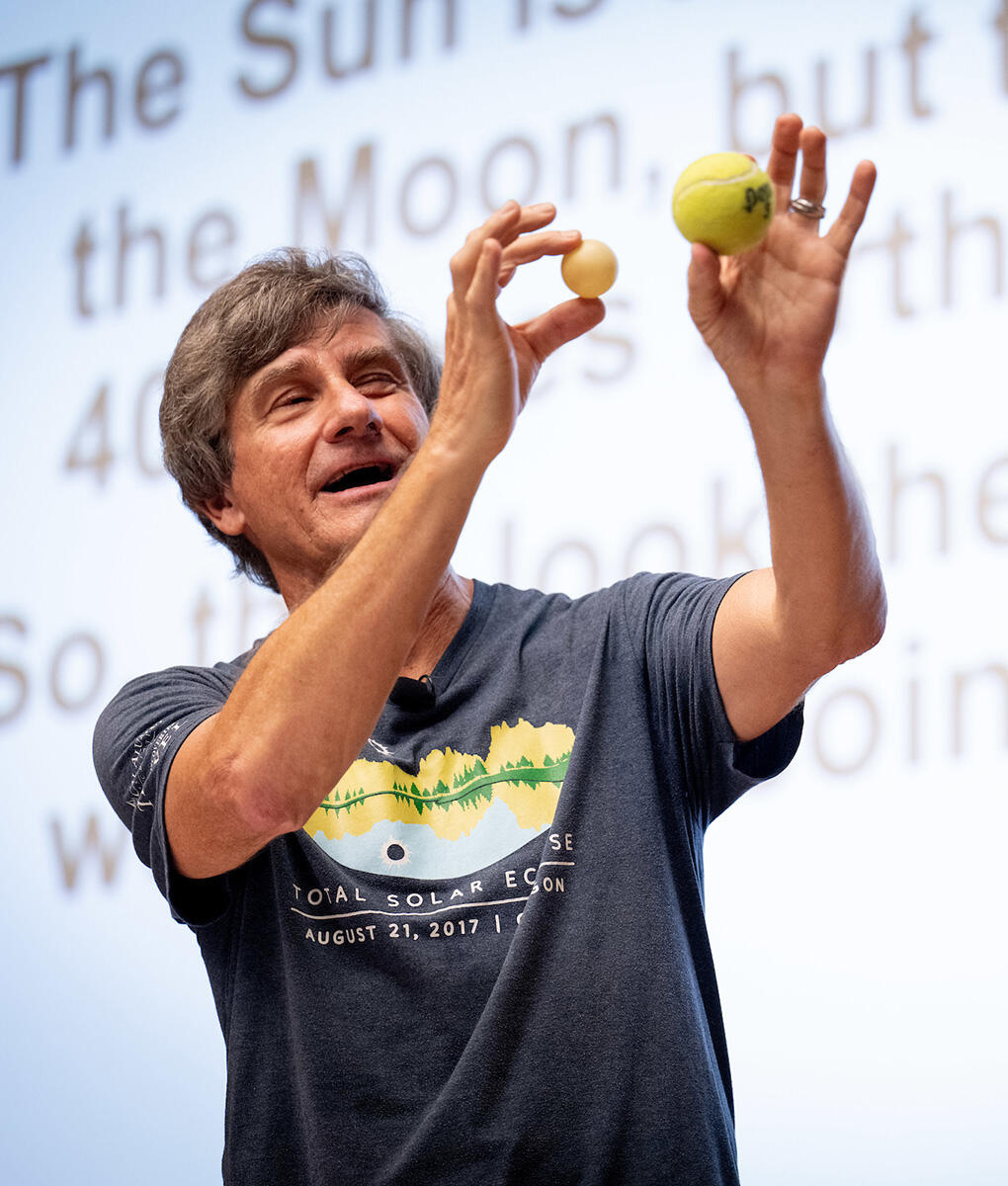
Filippenko arrived at UC Berkeley as a postdoctoral Miller Research Fellow in 1984 and joined the faculty just two years later. He quickly established himself as one of UC Berkeley’s most engaging lecturers — the Astronomical Society of the Pacific noted Filippenko’s “infectious enthusiasm” in its award announcement. Filippenko received UC Berkeley’s Distinguished Teaching Award in 1991 and has been voted “Best Professor” nine times. Last year, his “Introduction to General Astronomy” course had 790 students.

Filippenko has also made a major impact on astronomical research. He is among the most-cited astronomers, having published over 1,200 papers. Most notably, he served on both the Supernova Cosmology Project and the High-z Supernova Search Team — the only scientist to do so. These groups used distant supernovae to find that the universe’s expansion is accelerating due to dark energy, a discovery that earned each team’s leader the 2011 Nobel Prize in Physics. All team members, including Filippenko, earned 2006 Gruber Cosmology Prize and the 2015 Breakthrough Prize in Fundamental Physics.

Filippenko has extended his astronomical instruction outside of the classroom. He has co-authored major textbooks, advised popular television shows, produced dozens of hours of videos for The Great Courses, and given thousands of lectures and presentations. Filippenko is also an avid traveler who leads groups around the globe to view solar eclipses and offer lectures.

Filippenko joins good company with the other Dorothea Klumpke-Roberts Awardees. The first recipient was Carl Sagan, who also served as a Miller Research Fellow at UC Berkeley.

Alex Filippenko holds a ping pong ball and a (farther) tennis ball to demonstrate a solar eclipse.
PROFESSOR ALEX FILIPPENKO AT A 2024 HOMECOMING LECTURE